-
-
Here I was in the middle of St. Ives with a garden, a yard to work in with sun or moon above, and dreams of large works and freedom of action.
Barbara Hepworth 1970
-
Barbara Hepworth (1903–1975) was one of the most significant sculptors of the twentieth century. She developed a new vocabulary of forms that connote the natural world, and much of her work has an organic quality that parallels patterns of growth and form in shells, pebbles, leaves and trees. Yet her concern with the natural world was inseparable from a concurrent absorption in humanity, civilisation and its modernity, and the rapid advances of science and technology that took place in her lifetime. In the nineteen-thirties, she and her friends Ben Nicholson and Henry Moore made abstract and semi-abstract art that established them as leaders of the international modernist movement. In 1936, she became the first British sculptor whose work was purchased by the Museum of Modern Art, New York.
-

-
On Loan
-
-
After moving to Cornwall on the eve of war in 1939, Hepworth decided to remain there. Much of her sculpture and painting from that time onwards developed in concert with the changing tides and seasons of her local environment. In 1949, she purchased a spacious and secluded property called Trewyn at the heart of the Cornish coastal town of St Ives, which became her home and studio for the rest of her life and subsequently opened as a permanent museum dedicated to her work. Trewyn afforded her work spaces ideally suited to the carving of wood and stone and the working of plaster, which she used in preparation for bronzes. The large garden became the ideal setting in which she imagined her sculpture.
-
-
In 1956, Hepworth began to work in bronze having previously made limited use of the medium at the start of her career. In contrast to the restrictions imposed by specific pieces of wood and stone, the tensile strength of bronze allowed her to create expansive silhouettes made from flattened planes and interiors hollowed deep inside billowing walls. Her initial use of blue-green patination, the colour of sea and sky, contrasted with the polished, mirror-like finishes that she began to use in 1959. She often combined these finishes, and a work such as Miniature divided circle (1971) has polished exterior faces and patinated interiors. In several cases, Hepworth used bronze to replicate and preserve earlier sculptures in wood or stone such as Idol, a boxwood carving of 1955–56 that she made again with polished bronze in 1971. The largest work she made in her career, Single Form (1961–64), which still stands in the United Nations Plaza in New York, was also made in bronze.
-
-
-
-
Barbara Hepworth | Two Rotating Forms II
Artwork film May 14, 2026 -
Barbara Hepworth
Maquette: Theme and Variations, 1970 Silver and walnut wood
31 x 66 x 16 cm
12 1/4 x 26 x 6 1/4 in
Edition 2 of 6 -
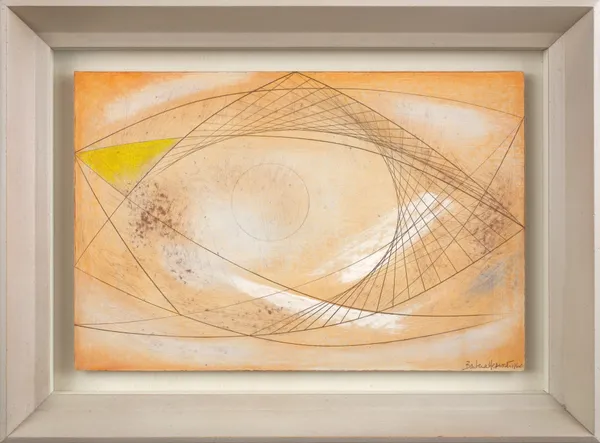
Alongside sculpture, throughout her career Hepworth made paintings and drawings. These works often mirror themes that preoccupied her in contemporaneous sculptures. In Rhythmic forms and Project for Sculpture (both 1957), Hepworth made looping organic structures from heavy black lines of paint. The same agile sense of movement is apparent in bronze sculptures of the mid-fifties. Hepworth often combined glowing grounds of thin oil paint, accumulated in layers of warm and cool colours, and lines and curves that connect to the ground with ‘a bite rather like cutting into a slate’. The interaction between a colourful ground and an overlaid drawing often creates imagined sculpture that is at once massive and weightless, volumetric and transparent.
-
-
-
For availability and prices please contact the gallery
-
Barbara Hepworth: Sculpting and Painting
Past viewing_room