In her series ‘Measure for Measure’, Bridget Riley used discs with colour for the first time. It marked a new development from the ’sixties when her discs were gradients of black and white.
InSight No. 196
Bridget Riley, Measure for Measure 27, 2018
At the outbreak of war in 1939, along with her mother, sister and aunt, Bridget Riley (b. 1931) evacuated from London and went to live near Padstow in Cornwall. She recently remembered those years to the journalist Kirsty Wark: ‘It was beautiful. We were not far from the coast. There was in fact nothing to do but look, and enjoy, and appreciate, and move around and walk in this extraordinarily beautiful landscape.’ It was a foundational experience. Unlike non-representational artists who paint from the soul, Riley’s art is inspired by visual experience and encounters with the natural world. She explained in 1996: ‘Of course, being in the studio is the heart of the matter, as it is for any artist. But going out and “looking” has been vitally important to me for as long as I can remember.’
Throughout her career Riley has asserted a connection between her art and nature, and her repetition and modulation of elementary forms is analogous to the endless and unique variation of cloud formations, breaking waves and other natural phenomena. In 2025–26, Turner Contemporary held an exhibition of her work conceived as ‘an opportunity to view Riley’s work against the context of the ever-shifting light, skies and tides of Margate.’ It was co-curated with the artist and showed recent works alongside paintings from earlier periods of her career. Her wave forms have seldom looked so wave-like as when the viewer sees the North Sea immediately before and immediately after. The exhibition emphasised Riley’s self-awareness as she has returned to ideas in earlier paintings and developed them in new ways. A recent series uses a repeating motif of triangles, some of which have a curved side, which she first devised in Fugitive (1962, Trustees of the Goldfinger Family) and latterly reinvented in a palette of ‘dark colours’ surrounded by a white border.
The Margate exhibition was subtitled ‘Learning to See’. To an extraordinary degree, Riley’s art goes to work upon the viewer’s gaze. Some visitors to the exhibition could be heard complaining: ‘It makes my eyes go funny.’ But one person’s perceptual hazard is another’s pleasant stimulus. Her work creates in the viewer an acute self-awareness of how and what one sees: how one’s gaze tracks across a surface; how close one stands to the work; how one’s vision echoes with an after-image. As The Guardian’s critic Adrian Searle observed about Riley’s paintings: ‘However analytical you might try to be, they continue doing things to you on a physical, phenomenological level.’
Beside triangles, stripes and wavy lines, another motif that recurs through Riley’s career is the disc. It first appeared in Black to White Discs (1962, Private Collection), which consists of a diagonal nine-by-nine grid. The discs range in colour from black to pale grey, and the brightening and darkening of hue from one disc to the next produces a ripple effect as if variegated light was passing over the surface. In 1963–64, there followed nine works in which discs contracted to suggest a gradual quickening towards a horizon, and then gradually expanded again on the other side of it. Their titles suggest a wide variety of poignant events: Fission, Loss, Pause, Hesitate, Metamorphosis, Remember, Release, Where, Balm.
The disc all but disappeared from Riley’s vocabulary of forms after 1967. But she rediscovered it in her series Measure for Measure, which began in 2016, and for the first time made discs with colour. The series has included large and small paintings on linen and some very large wall paintings, most prominently Messengers which was installed in the National Gallery’s Annenberg Court in 2019. John Constable called clouds ‘messengers of the sky’, and in Riley’s installation the discs of green, orange and violet seem to float in open space like glimmers of light in a cloudscape. Riley is not the only artist to use coloured discs, or ‘spots’, but her use of them is distinctive. Damien Hirst’s ‘spot’ paintings, for example, originated in a student work called 8 Pans, and his use of household gloss suggests a knowingly coarse, materialistic frame of reference altogether different from Riley’s work, which rather belongs in the serene, intangible world of optics.
Although the execution is less remarkable than the perceptual effect, Riley’s work is consistently made by a team of studio assistants with necessarily unerring precision. The paint is evenly applied; the discs are perfectly spherical; the linen is primed in brilliant, spotless white. In consequence, the discs appear to float free of their materials and seemingly enter a higher plane of pure optics. Measure for Measure 27 is composed from monochrome discs in three colours laid in a diagonal grid pattern, and our eyes chase up and down the diagonal lines. Several sequences run diagonally in a single colour, or alternate between two colours, and one is conscious of trying to discern a rule that determined the distribution of colours. Our focus jumps from colour to colour and, as this happens, we track across the surface in search of the same colours, almost blind to the others. No two green discs run consecutively along the diagonal and we leap around to discover them. No less than her pivotal works of the ’sixties, Riley’s recent paintings work upon the visual sense with great intensity. Like a brick going through plate glass, their impact on the viewer is irresistible.
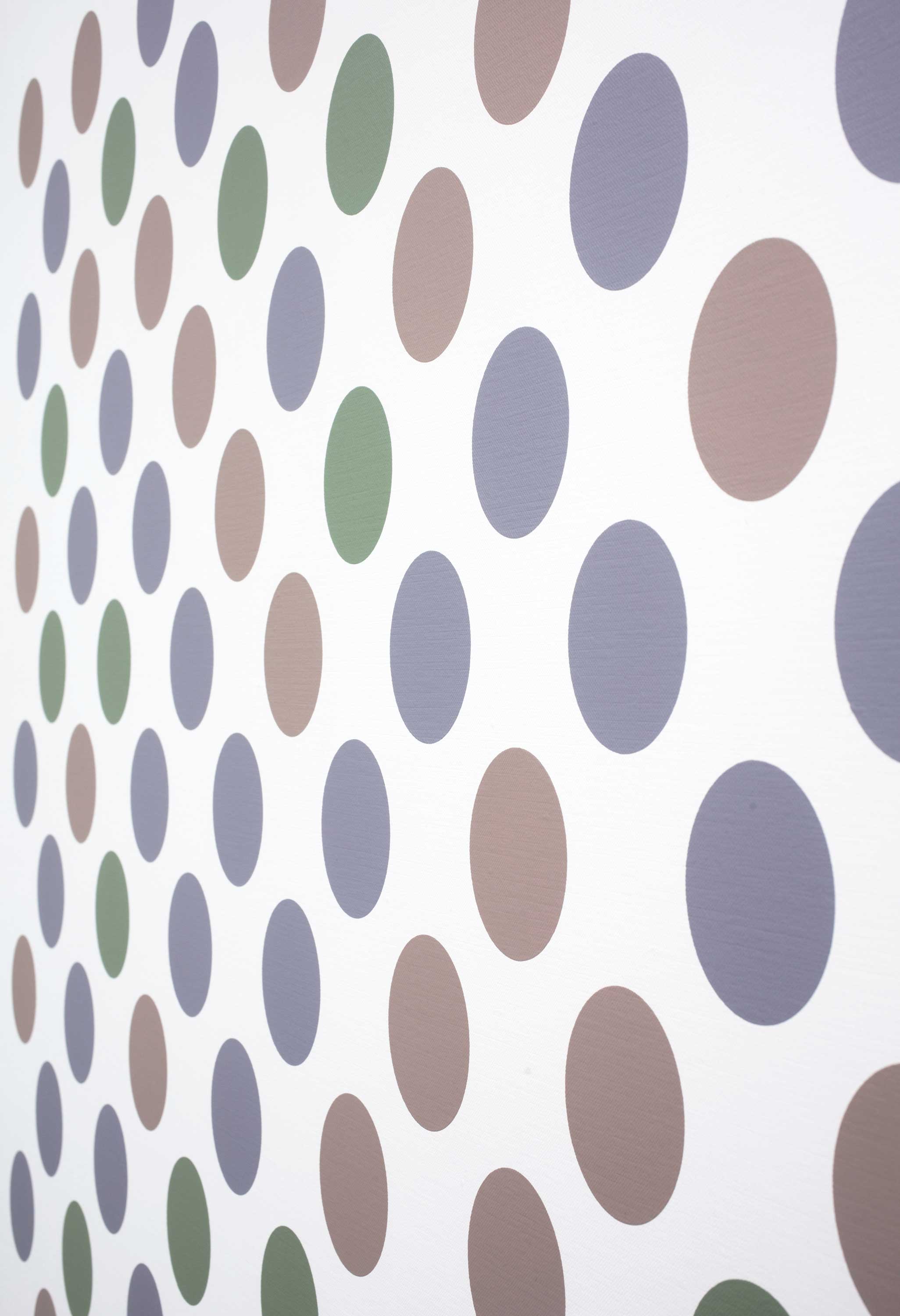
Bridget Riley, Measure for Measure 27 (detail)