To coincide with Piano Nobile’s display of the artist’s work, InSight considers a recent tapestry by Grayson Perry.
InSight No. 186
Grayson Perry, Fascist Swing, 2025
As the Wallace Collection states with pride and accuracy, The Swing is Jean-Honoré Fragonard’s ‘most famous work’. The sight of a young woman, suspended mid-air as her flamboyant pink dress billows around her, is one of the enduring images in the history of oil painting. Her older, doting husband who pushes the swing, lost among shaded boughs in the background, has lost the woman’s affection; perhaps he never had it. Her young lover reclines in the undergrowth and she kicks off her slipper towards him, suggestively revealing her petticoats as she does. The image conveys the situation with supreme elegance and clarity: her intimacy with the young man in the bushes, the impotence of her affluent marriage partner, her direction of travel literally from one to the other.
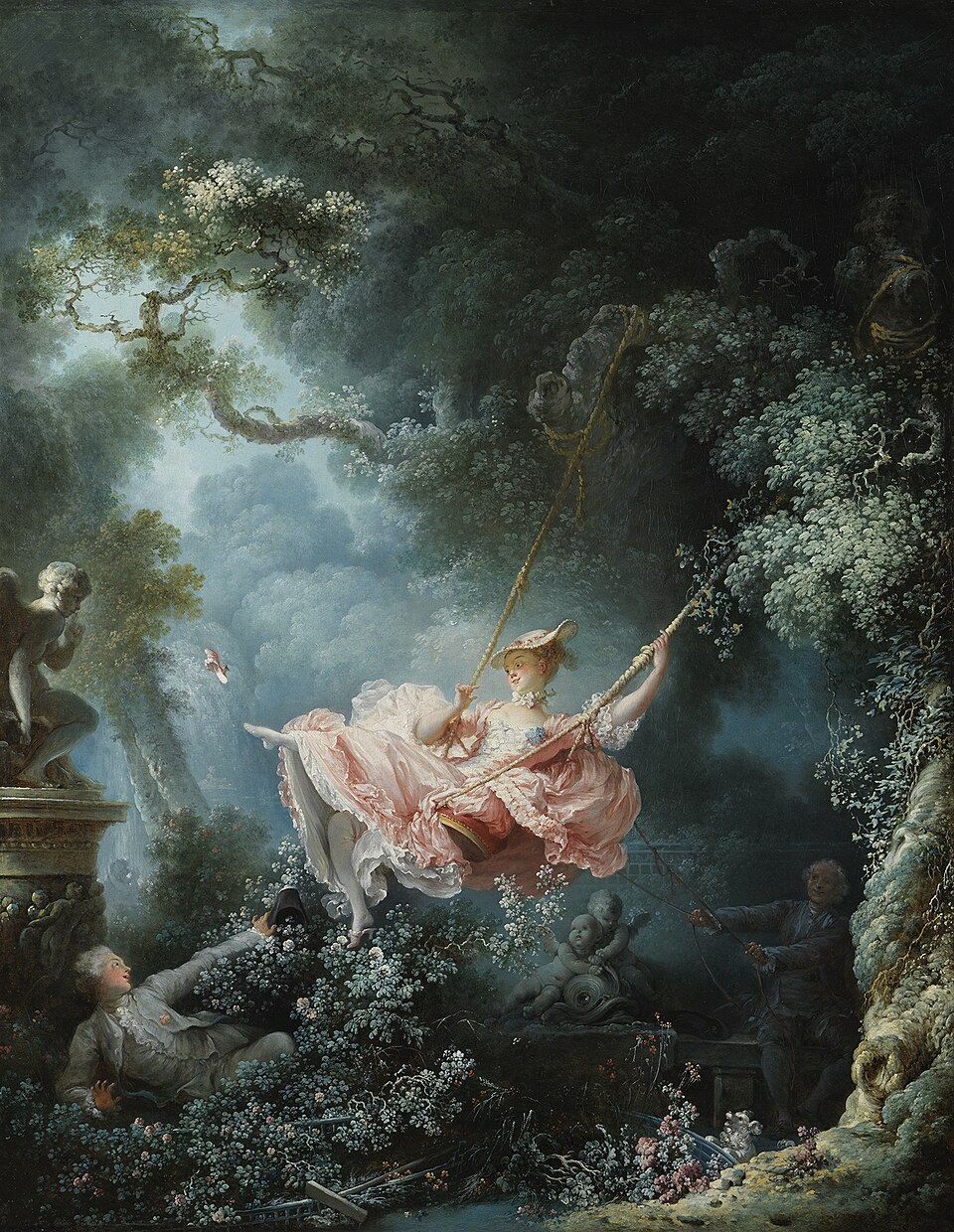
Despite the implication of infidelity, the image is not sordid and has often been appropriated for more or less innocent purposes in other visual media. It was perhaps one of the antecedents that led to Marilyn Monroe’s famous skirts-up moment in The Seven Year Itch. More recently, Princess Anna in Disney’s popular animated feature film Frozen floats before a version of the painting. Dreaming of love, she is briefly substituted for the young woman on the swing who is pushed by a besotted young man. The second male figure and the plot about an illicit romance were conveniently erased.
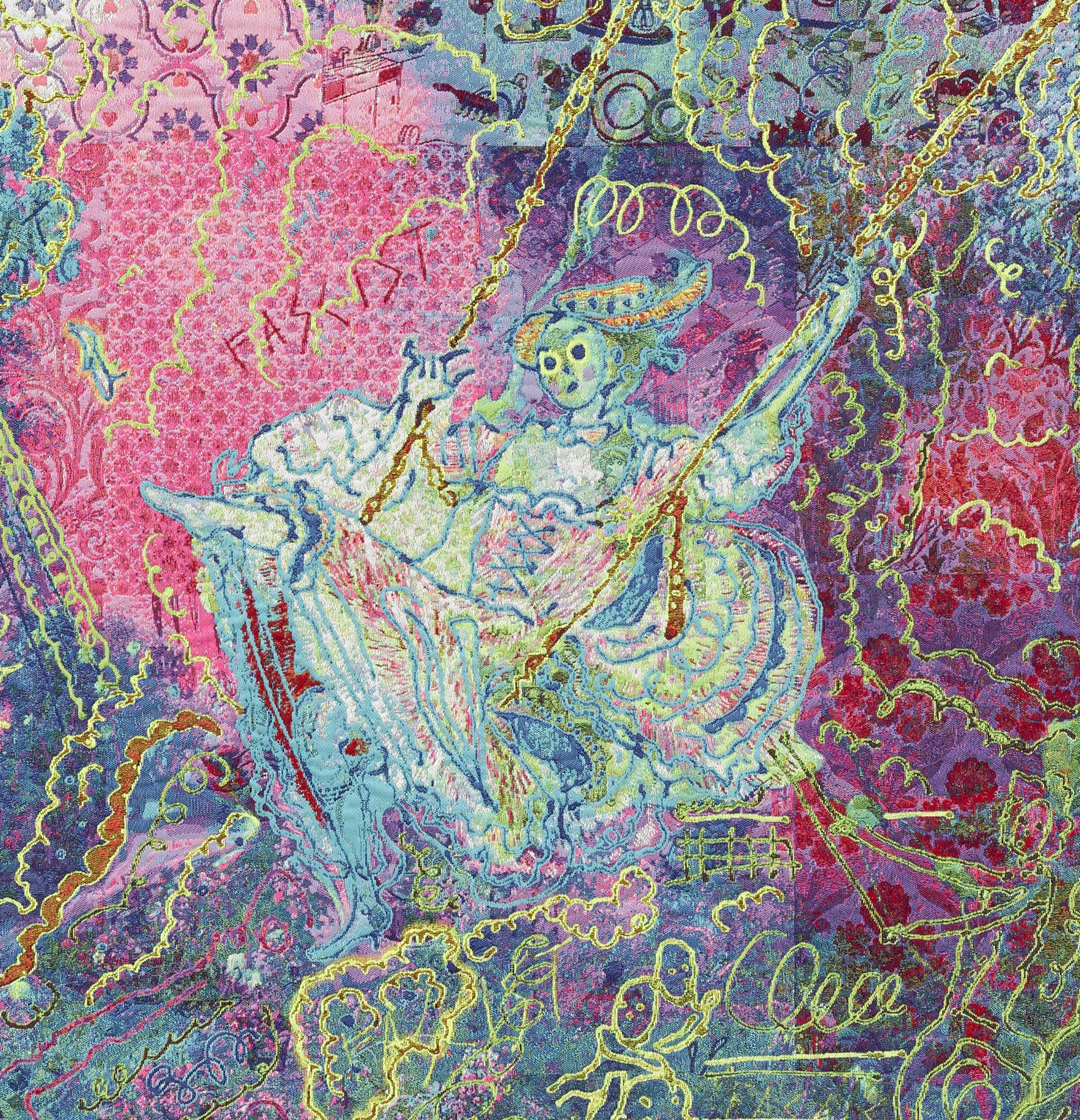
In Grayson Perry’s (b. 1960) large tapestry Fascist Swing, Fragonard’s witty composition is reconfigured again. But not as Grayson Perry would handle it, but rather as his invented alias Shirley Smith (see InSight 174). A troubled and abused Eastender, she believes herself to be the ‘thwarted legitimate heiress’ to Hertford House—a psychotic ‘delusion of grandeur’ akin to the reasonable aspirations of the average lottery ticket holder. For his exhibition at the Wallace Collection in 2025, Perry devised a metafiction and presented Fascist Swing as if it was made by Shirley Smith. An outsider artist, Smith was said to have discovered art in Claybury Mental Hospital in Woodford Bridge, London, and her character was partly inspired by another self-taught artist from East London, Madge Gill (1882–1961), whose media included drawing, knitting, weaving and crochet.
In Fascist Swing, the palette of luminescent pink and green playfully intensifies and distorts the colour of Fragonard’s painting, while the imagery includes the slipper and all three figures. But the men appear only in silhouette, as Perry explains: ‘Shirley downplays the erotic subject matter of the original and the two men disappear into the background’. By contrast, the woman on the swing has a robust, magisterial presence. Her skin is green, the lineaments of her costume are cobalt blue, and her blackened eyes are ringed in yellow. This gaze has a consuming, uncontrolled intensity, and the woman is perhaps some ancestor of Shirley Smith’s, or even Smith herself.
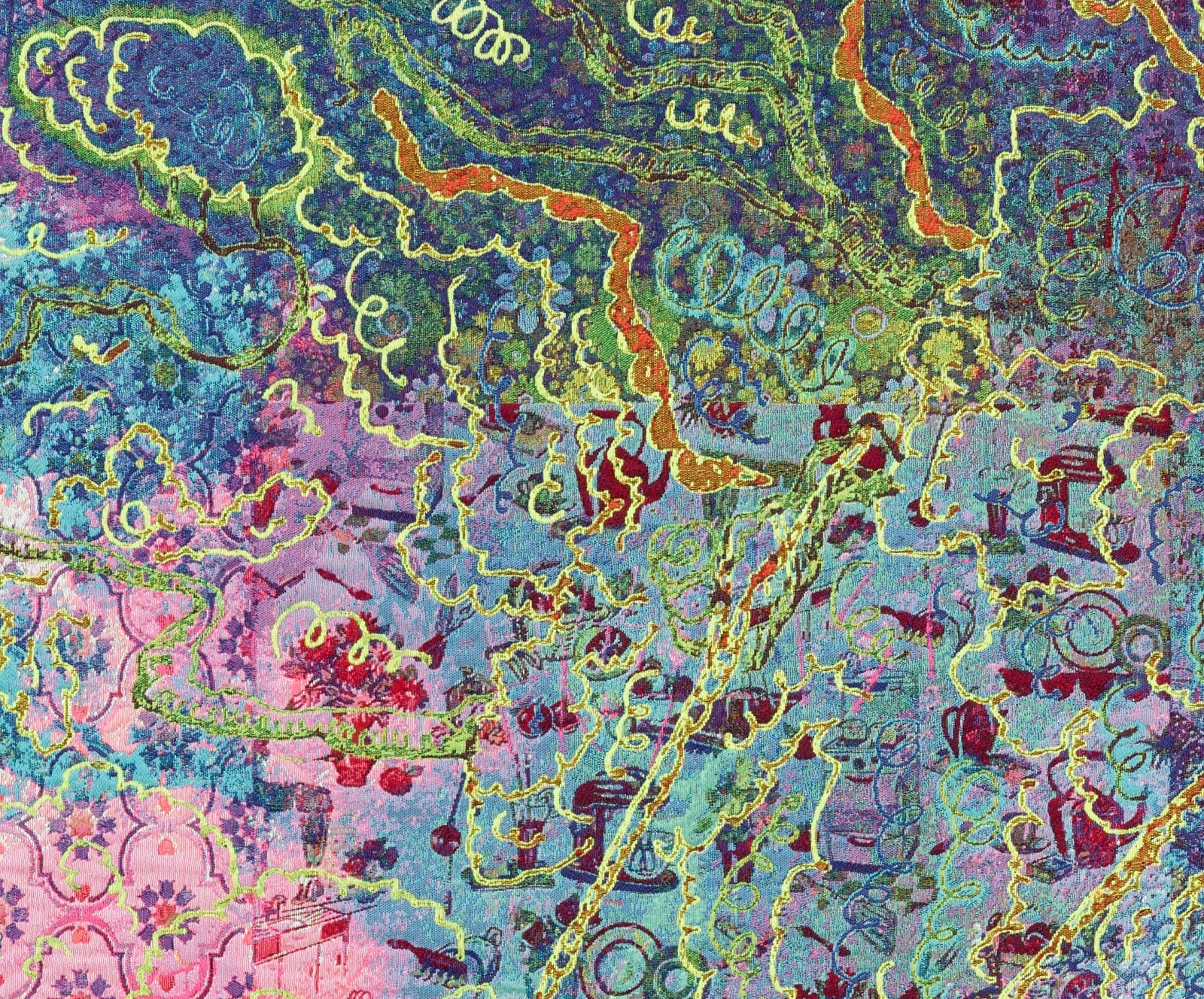
Perry elaborated his metafiction with characteristic thoroughness. In Fascist Swing, the bucolic background of The Swing is overgrown with the imagery of kitchen mixers, cookers and kettles. Although the tapestry was woven in Italy and made by the artist using computer aided design, Perry states that it was ‘obsessively hand-sewn [by Shirley Smith] onto a patchwork of cheap domestic fabrics from the 1960s and 1970s’. The conceit is well justified by the dense bricolage of pattern, colour and ornament.
Perry gave his metafiction still greater authority by quoting the invented opinions of ‘modern commentators’, who reportedly describe Fascist Swing as ‘a proto-craftivist outburst against the government and aristocracy for their refusal to restore Shirley Smith’s birthright’. In Perry’s translation of Fragonard, there is nothing more obviously fascistic than the graffitied word ‘FASCIST’ scrawled above the woman on the swing. By way of explanation, Perry claims that ‘the word “fascist” was sewn several times onto the fabric before the main image was applied’. In the context of Shirley Smith’s fictitious life, the word registers as a wanton outburst summoned from the depths of a troubled mind. Yet in the hands of Grayson Perry, such outbursts are the materials of his craft: carefully sustained, developed, elaborated and layered up, they are harnessed to create witty, jarring and elusive images whose visual immediacy is inimitable.
Images:
Jean-Honoré Fragonard, The Swing, c. 1767–68, oil on canvas, 81 x 64.2 cm, Wallace Collection, London
Grayson Perry, Fascist Swing (detail)
Grayson Perry, Fascist Swing (detail)