With half a dozen large blue paintings made between 1959 and 1961, William Scott began a decade-long exploration of abstraction.
InSight No. 185
William Scott, Circles Diminishing, 1961
William Scott’s (1913–1989) career included two discrete phases in which he made wholly abstract paintings. The first was limited to a few works made in 1952–54, among them Orange, Black and White Composition (1953, Tate). All divided the canvas with rectilinear forms, which sometimes constituted a grid-like pattern and often rhymed with table tops he had painted at an earlier stage of his development. The second period was much longer and more sustained. It began in 1959 and continued for a decade, and the abstract forms or motifs of this phase often had soft, rounded edges.
In 1959, 1960 and 1961, Scott made several sophisticated large-format paintings in which the dominant colour was blue accompanied by black and brown or limited areas of white. The title of certain works suggests the importance of this colour scheme: Blue Abstract; Blue Painting; Blue, Grey, Blue; Ocean. The emphatically sober, serious mood of these paintings resulted partly from the exclusion of local complementary colour, which Scott had used in Blue Still Life (1957, Leeds Art Gallery) and Interior (1958, Private Collection), for instance, which inserted small panels of orange and yellow respectively amidst fields of white, brown and blue. Scott’s palette in the early sixties was tightly restricted to gradients of black, white, blue, brown, orange and ochre, and most of his paintings made at that time have monochrome areas in which colour and paint texture were afforded the greatest possible legibility.
In all Scott’s work of this period, but especially the deep blue paintings of 1959–61, a narrow palette helped to intensify the visual presence of surface texture. In Circles Diminishing, the entire canvas is dense with widely varying kinds of paint application. A large irregular square of bright blue, glowing and richly painted, floats against a moat of warm brown paint, which is contrastingly thin, matt and sunken into the absorbent canvas. This pronounced textural difference and the contrast of a light colour against a dark one cause the bright blue square to float forwards of the border area. (The same contrast of colour and texture was used in Black, Grey and Blue, illustrated above.)
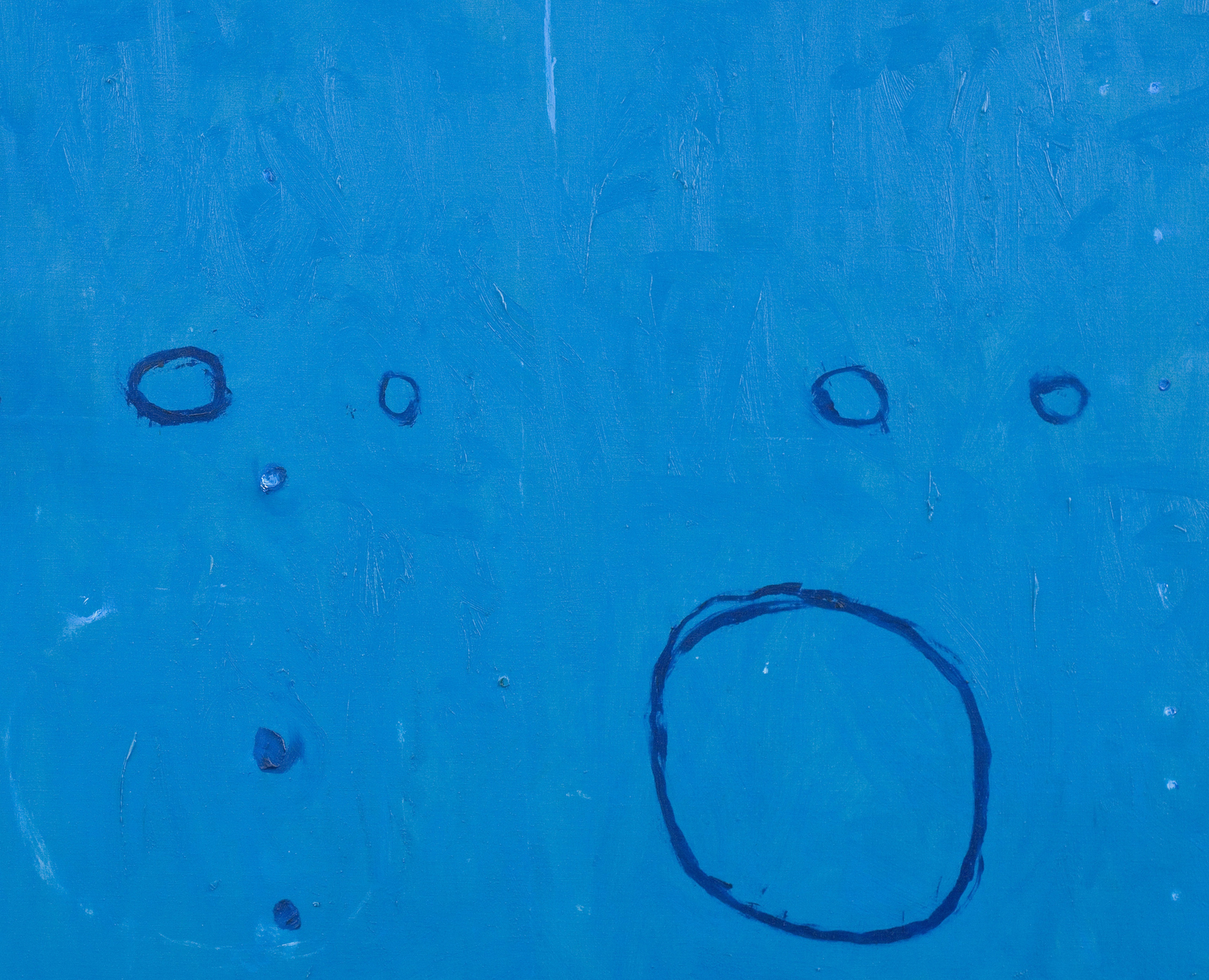
The square in Circles Diminishing was painted with great energy, and notwithstanding the homogeneous consistency of the paint, a dense skein of sweeping brushstrokes is apparent. Paint was applied haphazardly to avoid any sense of pattern, and different strokes have varying weights and more or less impasto. At the surface of the large square, uneven circles, lines and spots of ultramarine and white were applied with similar informality.
The square in Circles Diminishing was painted with great energy, and notwithstanding the homogeneous consistency of the paint, a dense skein of sweeping brushstrokes is apparent. Paint was applied haphazardly to avoid any sense of pattern, and different strokes have varying weights and more or less impasto. At the surface of the large square, uneven circles, lines and spots of ultramarine and white were applied with similar informality.
Sometime after 1957, William Scott explained to Alan Bowness the special importance he attached to the physical presence of paint on canvas: ‘the actual touch and the way I put paint on canvas matter very much […]. I am extremely interested in textural qualities—the thick paint, the thin paint, the scratched lines, the almost careful-careless way in which a picture’s painted’. He further described his disdain for ‘a picture painted with a too slick, too efficient technique’. Bowness was a sympathetic ear and admired Scott’s paintings. Using the fee from his monograph about Scott, published by Lund Humphries in 1964, he purchased a large blue painting from 1960/61 called Ocean. In December 2025, Kettle’s Yard announced that the painting would be displayed in the house as part of a year-long loan. In his book, Bowness found Ocean and other such ‘big pictures of 1960 […] simple to the point of a grave emptiness’. He further observed that ‘they can mean little in reproduction’.
Paintings such as Ocean and Circles Diminishing were succeeded by abstract work of a subtly different kind. While living in Berlin in 1963–64, Scott began to make the so called ‘Berlin Blues’ paintings (see InSight 154). These differed in regard to texture, which became smooth and flat; palette, which became bright and luminous; and the shape of motifs, which became more definite. A comparison of these consecutive phases in Scott’s career emphasises the distinct qualities of each, yet each one demonstrates his peculiar authorial hallmarks. Large-format canvases, which first became popular in New York, became his testing ground. Some of his most distinctive work was made on canvases that filled a wall like a mural, and such formats allowed Scott to magnify the impact of colour and shape. In Circles Diminishing and many Berlin Blues paintings alike, his distinctive alphabet of elementary shapes was grand, arresting and ultimately undecipherable. As Alan Bowness wrote after he had lived with Ocean for fifty years, ‘it still remains mysterious to me’.
Images:
William Scott, Circles Diminishing (detail)