Stanley Spencer’s masterpiece is the Sandham Memorial Chapel at Burghclere in Wiltshire. While working on the project, he lived in a cottage nearby and drew some of Burghclere’s residents. Two of his drawings appear in Piano Nobile’s new online Viewing Room.
InSight No. 184
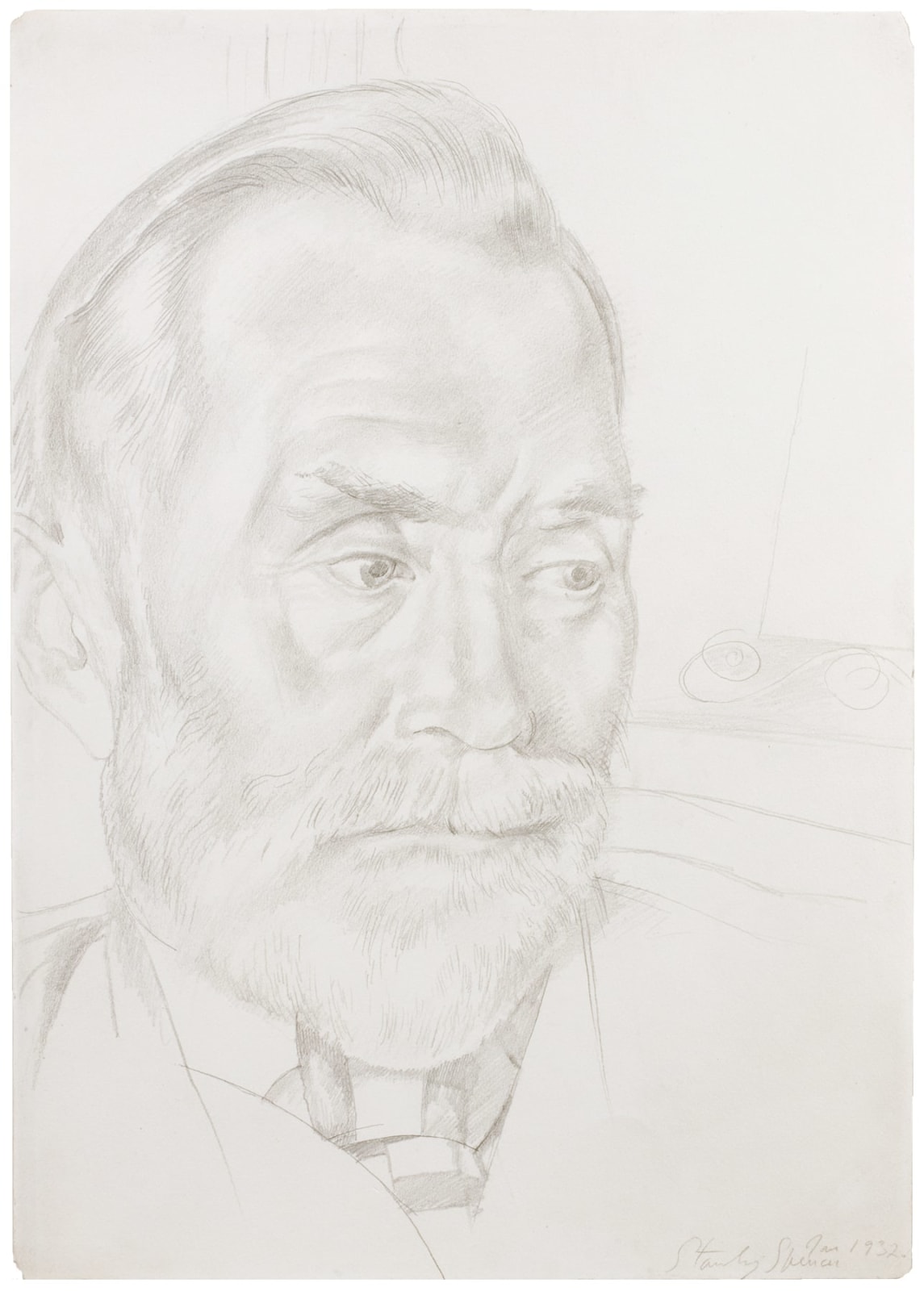
Stanley Spencer, Portrait of W. G. Head, 1932
Even the most casual students of history are familiar with Cleopatra’s nose. ‘If it had been shorter,’ wrote Blaise Pascal in the seventeenth century, ‘the whole face of the earth would have been changed.’ The historian E. H. Carr called it a red herring. At Luxor some two millennia after Cleopatra, Howard Carter and the Earl of Carnarvon discovered the tomb of Tutankhamun. Lord Carnarvon afterwards sustained a severe mosquito bite, which became infected following a razor cut, and he died in 1923. At home in England, over a thousand acres of Carnarvon’s Highclere estate was sold to pay death duties. And so Stanley Spencer’s (1891–1959) patrons were able to purchase the land on which the Sandham Memorial Chapel was built, and so one of the great artworks of the interwar years came to fruition. How different the history of twentieth-century British art might have been if Tutankhamun’s tomb was never discovered.
Stanley Spencer conceived the chapel built at Burghclere some years before he had an opportunity to realise his grand vision. The murals he eventually painted describe his own experiences of the Great War, and his loyal patrons Mary and John Louis Behrend afforded him the freedom to choose his own peculiar subjects. Only as an afterthought was the Oratory of All Souls at Burghclere called the Sandham Memorial Chapel, in memory of Mary’s brother Lieutenant Henry Willoughby Sandham who died from an illness contracted while serving in Macedonia during the war. For Spencer, the chapel decorations resounded with personal experiences that he took to be of a sacred kind. The format at Burghclere was inspired by the Scrovegni Chapel in Padua, which was painted with frescoes by Giotto in the fourteenth century. Yet Spencer’s peculiar intermingling of art history, devotional typologies and personal memory guaranteed the altogether different impact and atmosphere of his own chapel.
Spencer, his wife Hilda and their baby daughter Shirin lived at Burghclere while the chapel was being constructed and while he painted the murals. They went to live as guests at Palmer’s Hill Farm in May 1927 and moved the following year into a cottage called Chapel View, which was closer to the work site. The Behrends had it built especially for the Spencers, and construction was undertaken by W. G. (‘Bill’) Head who also built the chapel.
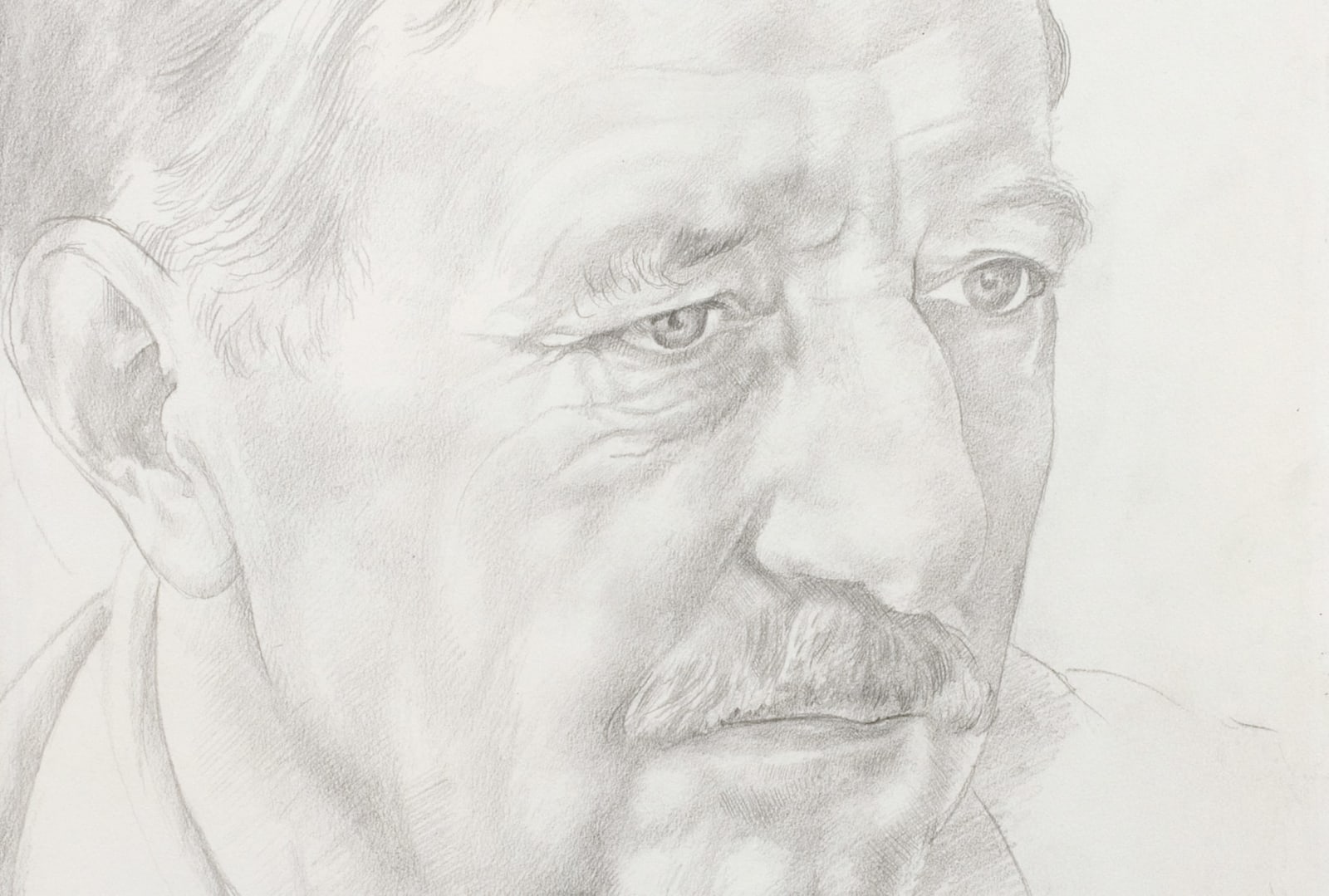
Bill Head, described on his invoices as ‘builder, decorator, undertaker &c.’, made a firm impression on Spencer’s imagination. It was people like him that were responsible for constructing the Scrovegni Chapel some six centuries earlier. The dynamic of Spencer’s thought tended to collapse such distances of time and place, and in his eyes the far flung (even Biblical) past could seem quite immediate and accessible. Having completed most of the Burghclere murals Spencer moved to his native Cookham in mid-January 1931, but on the eve of his departure he made two drawings of people who were intimately connected with the chapel: Bill Head and Albert Symes.
Unusually, the chapel at Burghclere was flanked immediately on either side by two almshouses called Sandham Cottages. This consideration reflected turbulent economic conditions at the time, which included the General Strike of 1926 and a sustained depression during the thirties. One of the first occupants was Albert Symes, a worthy beneficiary who had lost an arm and a leg some decades before during the construction of the Didcot, Newbury and Southampton railway line that ran close to the chapel site. Besides drawing his portrait, which was purchased by the Behrends, Spencer also made some unrelated drawings in Symes’s cottage. According to an inscribed sketch in Spencer’s studio sale, held at Christie’s in 1998, he made at least one other drawing in Mr Symes’s sitting room at Burghclere.
Even after Spencer had departed for Cookham, the construction of the chapel at Burghclere remained in his thoughts. A painting of 1935, The Builders, was partly composed from a memory of the chapel interior. The central motif is a large, round-arched wooden frame, which narrowly resembles the shape of Spencer’s canvases along the side walls of the chapel. As he later recorded in one of his notebooks, Spencer remembered Mr Head checking that the canvases fitted tightly into their alcoves. The art historian Paul Gough has speculated that the frame in The Builders may have evoked the ‘sturdy template’ used in the construction of the chapel’s lunettes. While The Builders is conjured from Spencer’s imaginative world of conflated memories and emotional distortions, his portrait drawings of Bill Head and Albert Symes belong to that other register which he practised so incisively throughout his career: a mode of sober naturalism and sensitive characterisation.
Images:
Stanley Spencer, Portrait of Albert Symes, 1932, pencil on paper, 35 x 24.8 cm
Stanley Spencer, Portrait of W. G. Head (detail)