Craigie Aitchison’s paintings create a world apart from physical reality. His pictures of the Holy Isle in Scotland merged a real place with a sense of the beyond.
InSight No. 183
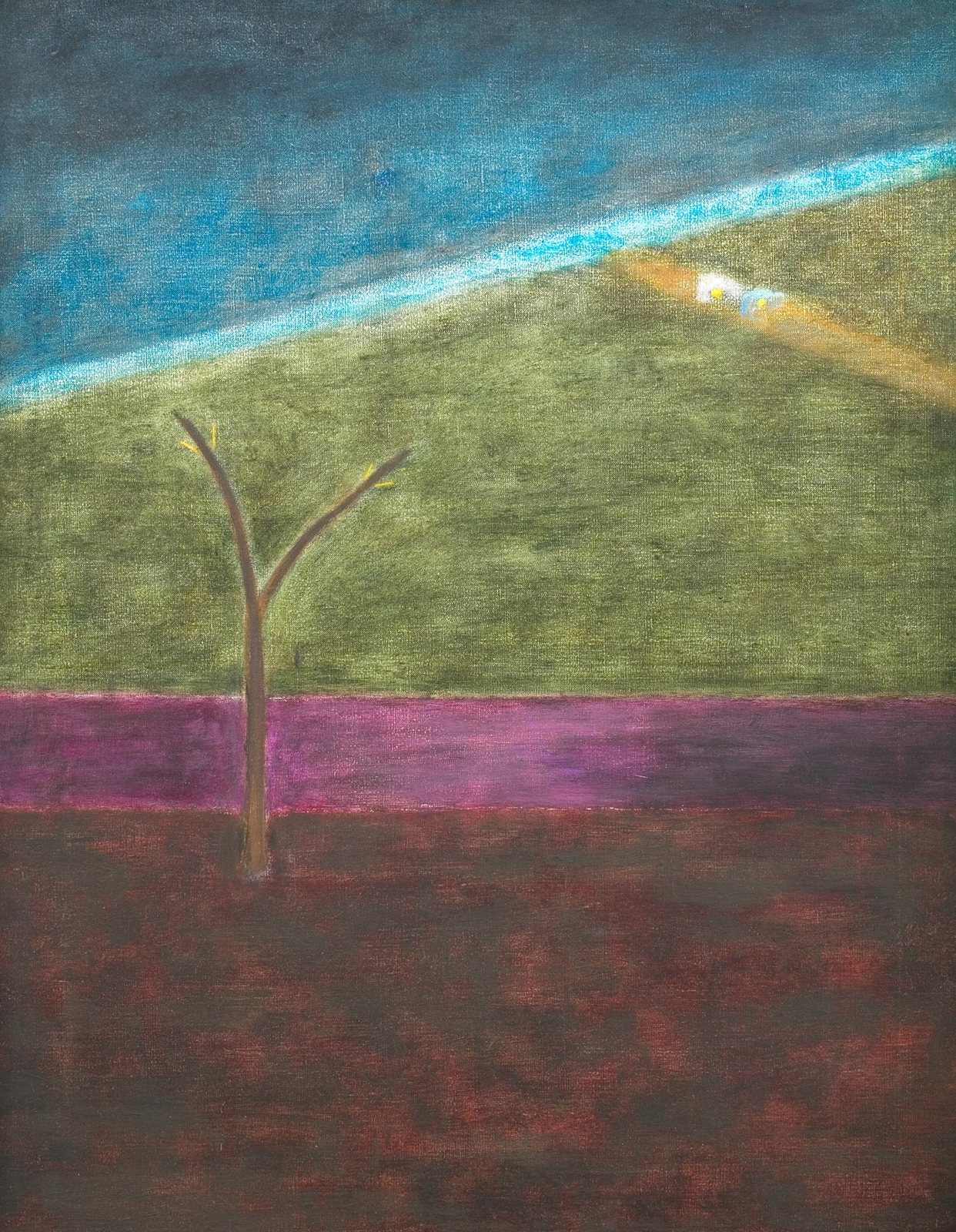
Craigie Aitchison, Landscape with Tree, c. 1971
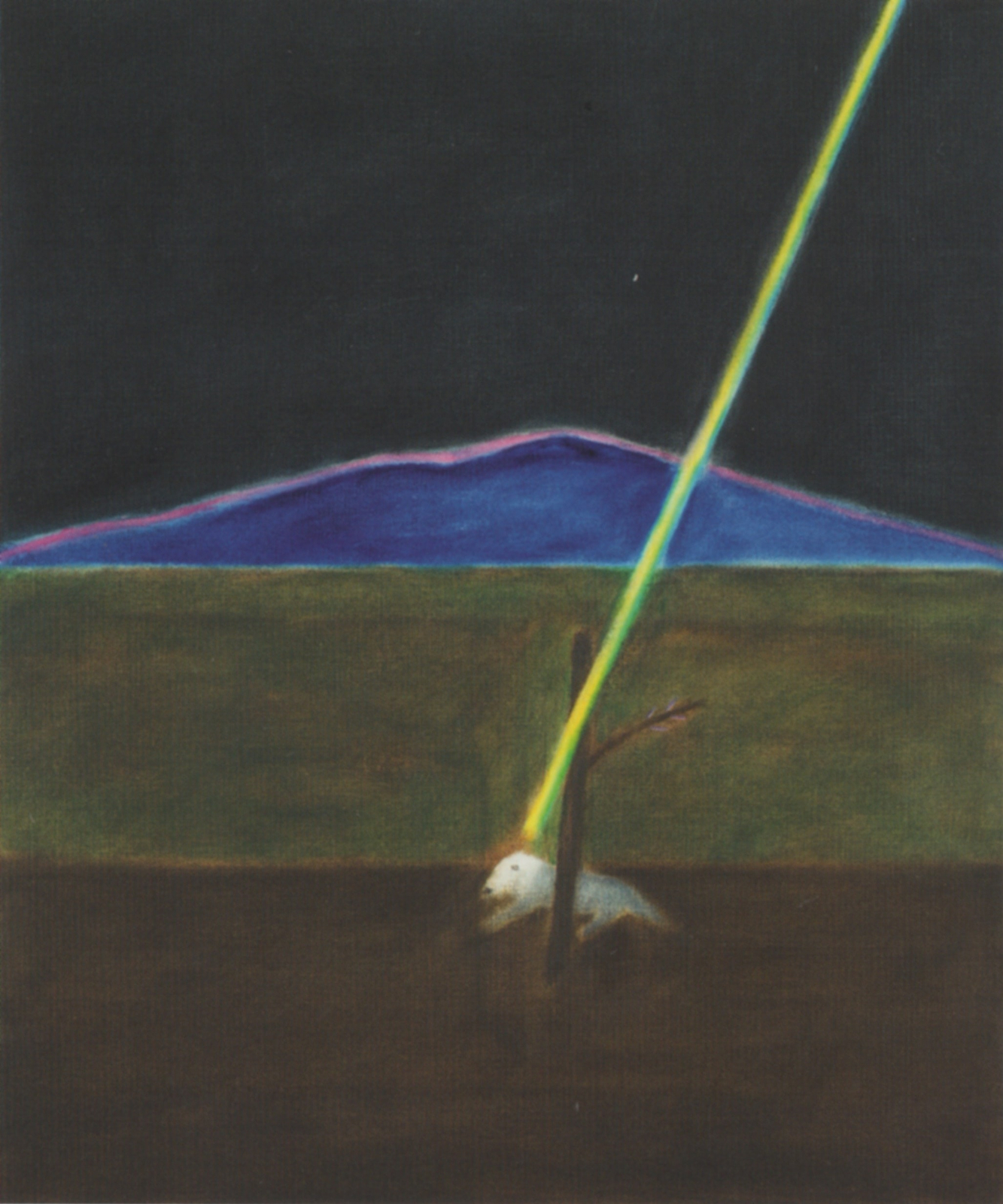
When his beloved Bedlington terriers died, Craigie Aitchison (1926–2009) sometimes made paintings to commemorate them. Rather than remembering his dogs as they were in life, as has long been a convention of memento mori portraits, Aitchison’s pictures show them ‘dead’ or ‘going to heaven’ as their titles indicate. One painting showed his dog Wayney, upside down in mid-air, rising above a crescent moon. Another, Sugarbush Dead, showed his Bedlington grounded but connected with the top edge of the picture by a brilliant diagonal line. A framework of glowing colour contributes to the uncertain status of all Aitchison’s subjects. They exist at one remove from the world, either as themselves or as spiritual impressions of themselves. Notwithstanding the often playful mood of his work, Aitchison had strong convictions and was alive to the soul in living beings, humans and animals alike. And the landscape and religious imagery he favoured often reflected this outlook.
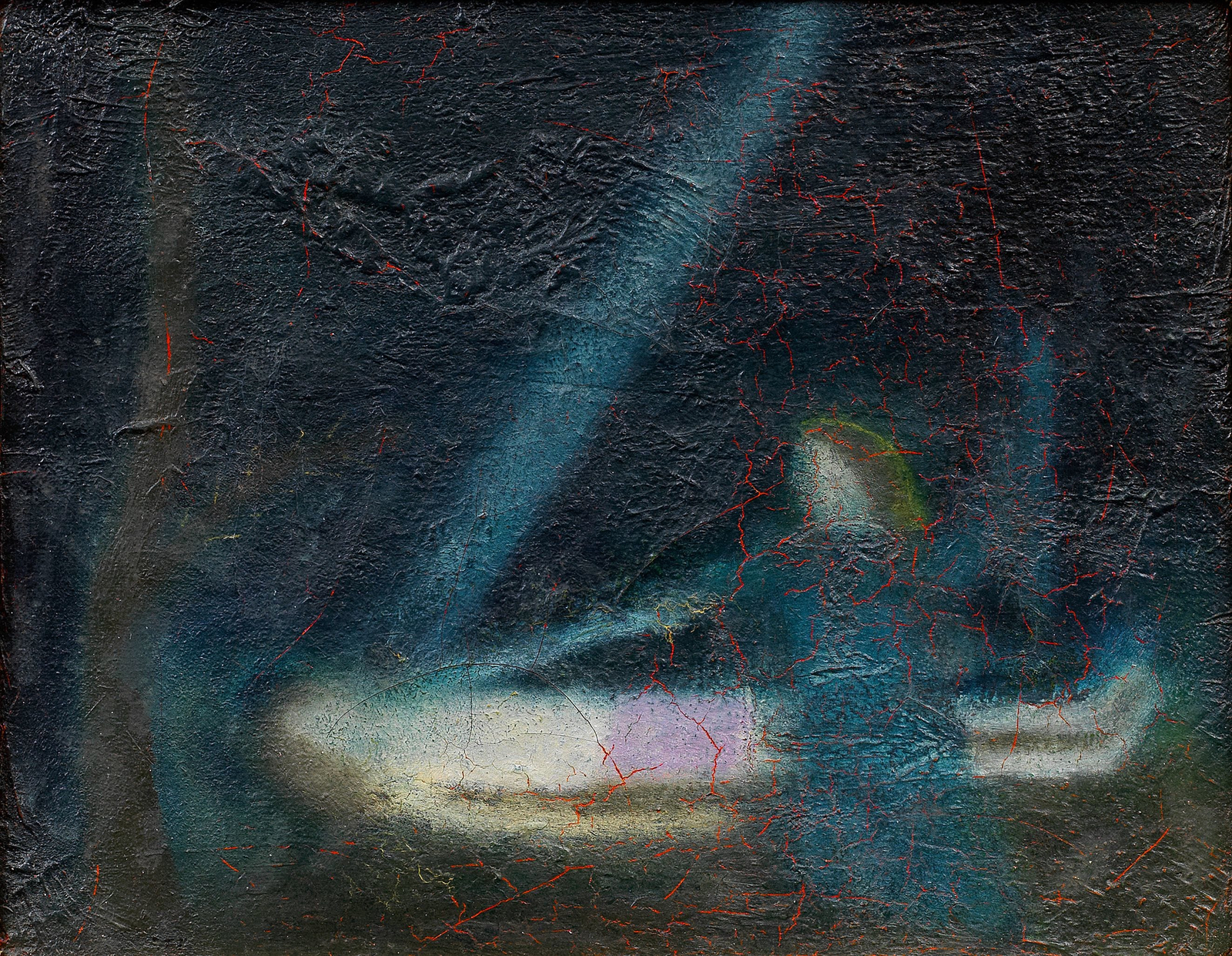
From the time he was a student at the Slade School of Fine Art and continuing intermittently for the rest of his career, Aitchison made paintings of the crucifixion. These works treated the figure of Christ with sympathetic tenderness. Beginning with paintings of the crucifixion and the lamentation made in the sixties, Aitchison showed Christ’s head emitting a spray of bright lights or occasionally a solid beam that rises to the top of the picture. These lights seem to indicate a spiritual transmission of some kind, as if the soul was leaving the body. In some crucifixion paintings, the ray of light does not reach the figure of Christ, and it seems as if the emission is coming down to earth rather than shooting outwards from the figure. In paintings of the sixties, angels frequently act as spiritual purveyors, and they minister to the ailing body as it gives up the ghost.
Besides Aitchison’s Christian iconography, his treatment of landscape subjects also alluded to a spiritual domain. Aitchison’s family was Scottish and he spent childhood holidays on the Isle of Arran. He was deeply familiar with the landscape of Goatfell and the view across the bay to Holy Isle. His father’s ashes had been scattered there and, when his mother died in 1970, he returned to the place to perform the same office.
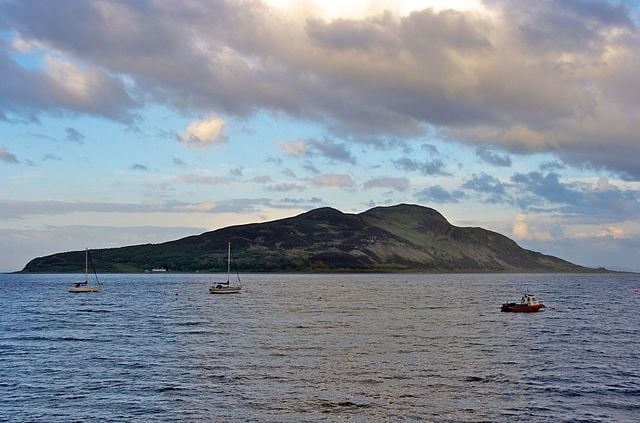
The visit reintroduced him to an enchanted vista: a wide horizon broken by the low, massive peak of the Holy Isle. He made his first painting of it almost immediately. The island has long been revered as a holy place owing to a spring with purported healing properties, which likely attracted the Irish monk St Molaise to become a hermit there in the sixth century. From these fringes of the world, monks such as St Molaise believed themselves closer to the presence of the divine. Aitchison in turn responded to this impetus, and it seems likely that this special place was connected in Aitchison’s imagination with the passing of his mother from one life into another.
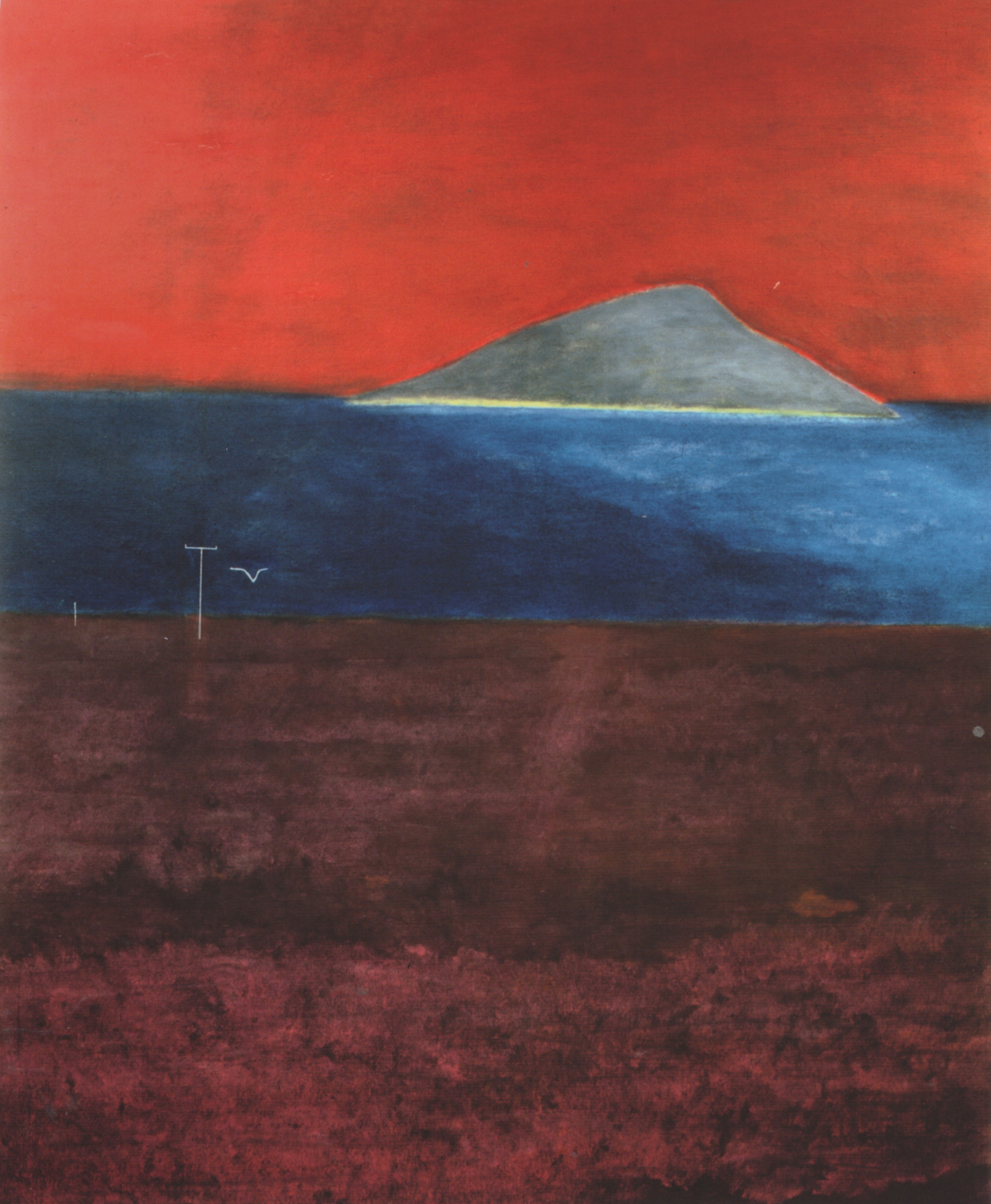
Aitchison repeatedly depicted Holy Isle in his paintings, and he often used it with great freedom as the setting for paintings of the crucifixion. In other cases, he painted landscapes devoid of figures yet charged with resonant colours and atmosphere. In Landscape with Tree, which Aitchison made a year after his mother’s death, the horizon is created by an ascending diagonal. The form resembles a closely cropped aspect of Holy Isle. A diagonal streak of warm colour breaks across the island mountain and suggests a ray of light. Intermingled with the light are two flower-like forms of blue and white, each with yellow seedheads. In keeping with Aitchison’s other depictions of streaking light, it seems possible that this ray of light represented to the artist a spiritual transmission of some kind. In certain other paintings of Holy Isle Aitchison included the arc of a rainbow, a crescent moon and a setting sun, which may evoke similar phenomena.
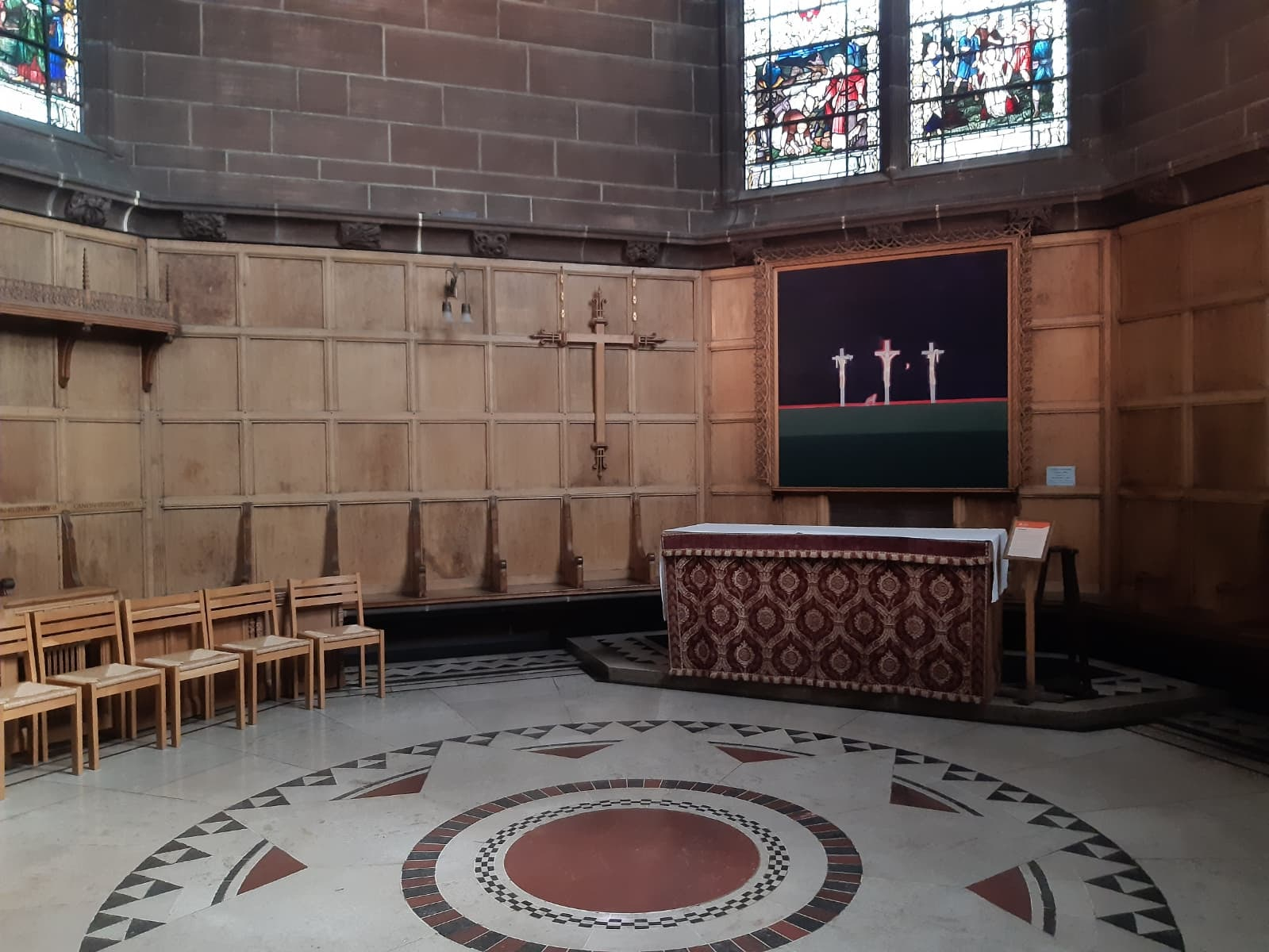
Although Aitchison had no apparent interest in organised religion, he was steeped in Christian traditions. His grandfather was a Presbyterian minister, and his parents took him to Presbyterian, Nonconformist and Roman Catholic church services as a child. He expressed sympathy for the circumstances of the crucifixion and would sometimes say ‘it was the most terrible thing that ever happened’. At the outset his paintings of Christian subjects were a response to youthful encounters with altarpieces in Italy (see InSight 118), and they developed from his intimate familiarity with Christian culture and imagery. Although he may never have intended any such paintings as instruments of devotion, later in life he was pleased for his work to be installed in the Anglican cathedrals at Liverpool and Truro.
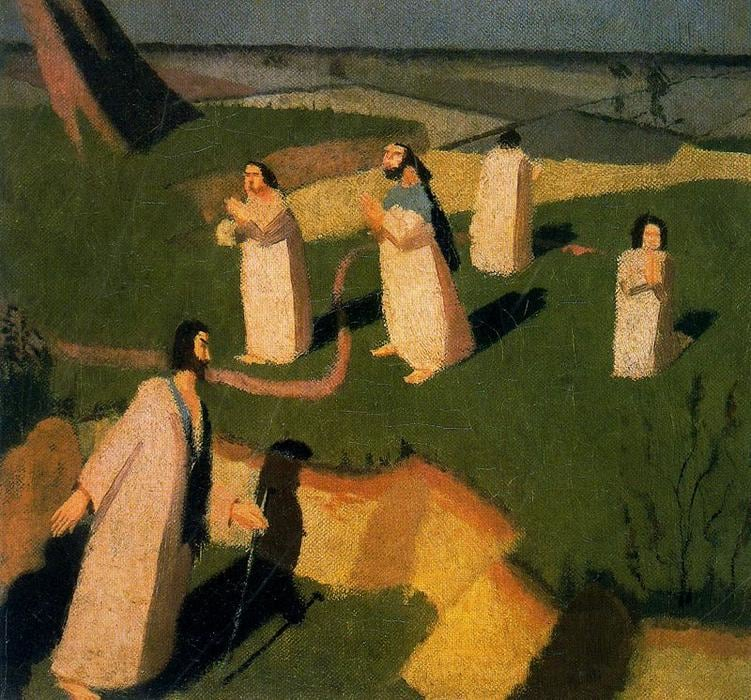
To describe any of Aitchison’s works as ‘religious paintings’ can be misleading. They rather belong to a broader field of spiritual activity that exists in other works by him, as paintings such as Landscape with Tree suggest. Aitchison belongs to a longer history of visionary painting in Britain, moreover, which encompasses William Blake and Stanley Spencer. The latter’s John Donne Arriving in Heaven depicts the dead poet taking his place in a verdant paradise redolent of rural England, much as Aitchison sometimes set the crucifixion against the backdrop of Holy Isle. Notwithstanding his aversion to poshness and pretentiousness, which forbade him from elaborating on the subject, Aitchison was receptive to ‘things in heaven, and things in earth, and things under the earth’. His paintings often project vistas into those inaccessible regions.
Images:
Craigie Aitchison, Sugarbush Dead, 1982, oil on canvas, 24 x 20 in, Private Collection © The Estate of Craigie Aitchison
Craigie Aitchison, Lamentation, 1963, oil on canvas, 8 x 10 in, Private Collection © The Estate of Craigie Aitchison
Lamlash Bay and the Holy Isle, 2011, photographed by Mike Peel
Craigie Aitchison, The Island, 1971, oil on canvas, 68 x 57 in, Private Collection © The Estate of Craigie Aitchison
Installation photograph of Calvary (1998) by Craigie Aitchison in the chapter house at the Cathedral Church of Christ, Liverpool
Stanley Spencer, John Donne arriving in Heaven, 1911, oil on canvas, 37 x 40.5 cm, Fitzwilliam Museum, Cambridge © The Estate of Stanley Spencer
Craigie Aitchison, Landscape with Tree (detail)